_______________
Additional Photos
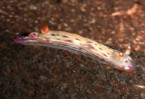
side
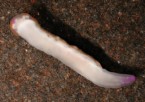
underside
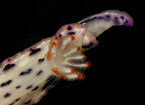
branchia
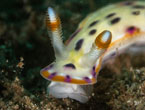
rhinophores
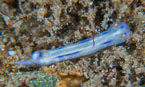
young
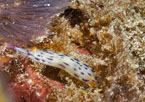
feeding
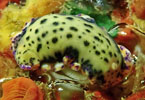
laying eggs
_______________
GALLERY

|
Hypselodoris bertschi Gosliner &
Johnson, 1999
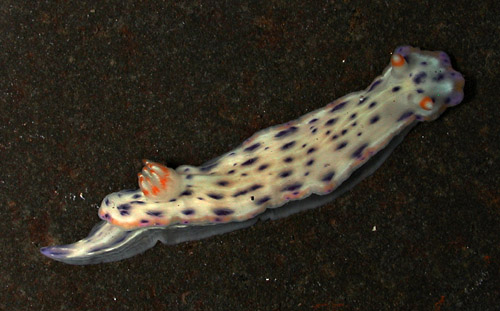
Maximum size: 35 mm.
Identification:
This
dorid
is translucent-white with elongate blue-black spots arranged
in longitudinal rows. Thin, white longitudinal streaks run between the
lines of blue-black spots. The mantle often has a broken, yellow-orange
marginal band in larger individuals. The rhinophores are white with a
single gold or orange medial band. Gill coloration appears to be
variable, either white with an orange rachis or white with orange tips
and an orange base.
Natural history:
Hypselodoris bertschi is
a
common
species found in rocky habitats. It occurs in protected to
highly exposed locations from
the low intertidal to 15 m (49 ft) and is often the most commonly seen
chromodorid on shallow reef flats. Although diurnally active, it may
rest in the open at night. It probably feeds on a black sponge. A 15 mm animal laid a cream, spiral egg mass
composed of about three whorls. It was 10 mm in diameter and the eggs
hatched in about seven days in the laboratory.
Distribution:
Big Island, Maui, Lanai, Oahu and Kauai: probably also found in Japan
and French Polynesia.
Taxonomic notes:
This
species
was listed
as Hypselodoris lineata
(Eydoux and Souleyet, 1852) in Bertsch & Johnson, 1981, Kay,
1979, and Kay & Young, 1969. It's also listed as Hypselodoris
sp. 1 in Hoover, 1998. It was named for Dr. Hans Bertsch who has
described many new
opisthobranch
species and has, among numerous other contributions, significantly
added to the knowledge of Hawaiian chromodorids. It's referred to as
the "dot-and-dash nudibranch" in Hoover, 1998 & 2006. It's listed in Ostergaard, 1955 as Glossodoris prismatica lineata and in Ostergaard, 1950 as Glossodoris sp. It's also listed as Glossodoris sp. in Edmondson, 1946. It was probably first recorded in Hawaii from Waikiki, Oahu by Jens Ostergaard in March, 1923.
Photo: CP: 25
mm: Hekili Point, Maui; April 30, 2006.
Observations and comments:
Note
1: ( )
|
|
