
| Home |
| Acknowledgments |
| Conventions |
| Glossary |
| Maps |
| References |
| Links |
| Articles |
| Thumbnails |
| Species
list |
| Family |
| Next
species |
Additional Photos
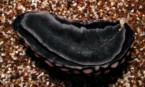
underside

side
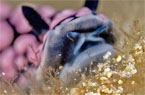
front
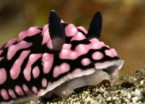
rhinophores
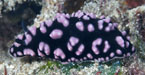 less pink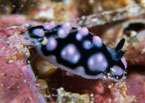
young

without flash
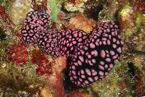
feeding
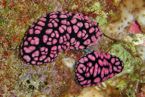
mating
_______________
GALLERY

Phyllidiella pustulosa Cuvier, 1804
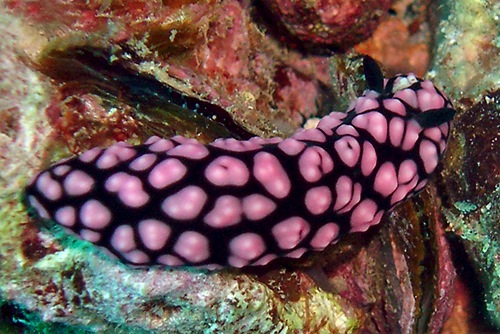
| Maximum size: about 51 mm
(Hoover, 2006). Identification: This species is elongate with low, irregularly-shaped clusters of smooth, conical, pink tubercles on a black notum. The tubercles are usually simple and there are occasional black lines ascending the sides of larger clusters. The mantle margin is edged in pale pink and the rhinophores are black. When seen underwater with the human eye, the animal may appear to have gray-green tubercles against a black background due to the absence of red light in deeper water. (see photo) It can be distinguished from Phyllidiopsis fissurata by its continuous pink marginal line and solid black rhinophores. It can be distinguished from Phyllidiella cf. lizae by the pink pigment overriding the posterior margins of the rhinophore sheaths. Natural history: Phyllidiella pustulosa is commonly found in the open in rocky habitats. It lives in moderately protected to highly exposed areas at depths of 4-26 m (13-85 ft). It has been observed feeding on an orange encrusting sponge of the genus Stylinos. Distribution: Big Island, Maui, Lanai, Molokai, Oahu, Kauai, Niihau, French Frigate Shoals and Kure: widely distributed in the Indo-Pacific. Taxonomic notes: This is probably the species listed as Fryeria ruppelli Bergh, 1889b in Kay, 1979 and as Phyllidia pustulosa in Bertsch and Johnson, 1981. (Note 1) The name means "full of pustules" referring to the many pink tubercles. It is referred to as the "pustulose Phyllidia" in Hoover, 1998 & 2006. There's some chance that the animals labelled "less pink" could be distinct. Photo: PF: Haloa Point, Maui; June 18, 2007. Observations and comments: Note 1: The photo in Kay's Fig. 153 appears to show a typical P. pustulosa. However, her statement that the rhinophores are white is anomalous. |
| Thumbnails |
Species
list |
Family | Next species | Top |