
| Home |
| Acknowledgments |
| Conventions |
| Glossary |
| Maps |
| References |
| Links |
| Articles |
| Thumbnails |
| Species
list |
| Family |
| Next
species |
Additional Photos
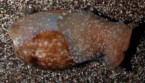
underside
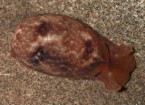
lightly spotted
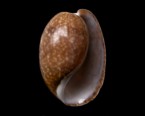
shell

Bulla vernicosa Gould, 1859
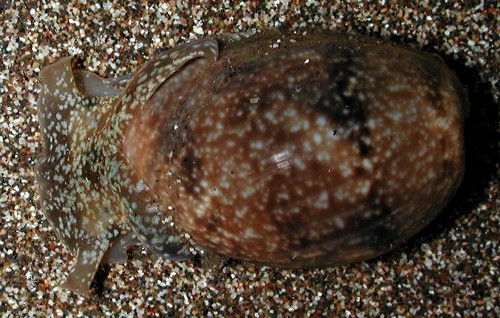
| Maximum size: 59 mm
(extrapolated from shell length); usually smaller. Identification: This species has a strongly inflated brown shell spotted with white and streaked with darker brown. The animal is cream frosted with brown and variably flecked with white. It may be distinguished from Bulla peasiana by its more strongly inflated and more heavily calcified shell as well as by the smaller translucent areas around the eye spots. (Note 1) Natural history: Bulla vernicosa is a moderately common species found in protected to moderately exposed mixed habitats and in Halimeda kanaloana beds at depths of < 1 to 15 m (< 3 to 49 ft). Dredged shells from the Bishop Museum extend the depth range to at least 183 m (600 ft). It is nocturnal, burying itself in sand or concealing itself under rocks during the day. It feeds on the green algae Enteromorpha and lays an egg mass composed of tangled, yellow strings (Kay, 1979). On Oct. 22, 1994 a tiny, orange commensal copepod was found on a large animal from Airport Beach, Maui. Distribution: Big Island, Maui, Oahu and Kauai (also Johnston Atoll): widely distributed in the western & central Pacific. Taxonomic notes: The photo labeled Bulla vernicosa in Kay, 1979 is actually Bulla peasiana (Kay considered that species a synonym of B. vernicosa at the time). The photo in Kay & Schoenberg-Dole, 1991 is also probably Bulla peasiana. It's listed as Bulla adamsi in Quirk & Harrison, 1972, Quirk & Wolfe, 1974 and Tinker, 1958. Photo: CP: 30 mm: Hekili Point, Maui; Nov. 17, 2006. Observations and comments: Note 1: Mykle Hoban reported on Feb. 9, 2017 that shells found on the bottom off Oahu showed strong red florescence under ultraviolet light. We subsequently confirmed the observation with a 395 nM UV flashlight. A photo by Marcel Koken of a Bulla sp. from Martinique (posted at Madibenthos) illustrates the phenomenon in the genus. |
| Thumbnails |
Species
list |
Family | Next species | Top |