
| Home |
| Acknowledgments |
| Conventions |
| Glossary |
| Maps |
| References |
| Links |
| Articles |
| Thumbnails |
| Species
list |
| Family |
| Next
species |
Additional Photos

cerata detail

underside

front

side

notum

pale

dark

resting cluster

young, 3 mm

mimicry model?

egg mass
_______________
GALLERY

Cyerce elegans Bergh, 1870
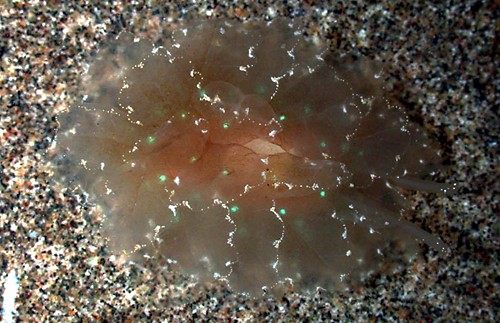
| Maximum size: 40 mm. Identification: This species is translucent cream to dusky brown. (Note 1) The broad, pillow-like cerata are edged with cream flecks and often show an iridescent internal green spot under some lighting conditions. Rarely, it may have narrow dark lines on the margins of its cerata. (see photo) When examined closely, the cerata are usually divided into sections by a network of transparent vein-like lines. However, some animals, particularly juveniles, may lack visible lines. Natural history: Cyerce elegans is a common species found in Halimeda kanaloana beds at depths of 10-27 m (33-90 ft). On Maui it only rarely occurs in rocky habitats at depths of 1-5 m (4-16 ft). However, on Oahu, it may occasionally be common in protected rocky areas at depths of as little as 1-2 m (4-6 ft) occurring in association with other species of Halimeda. It's nocturnal but may be found under pieces of rubble/debris or nestled at the bases of the alga during the day, often in pairs or clusters. (Note 2) We've observed it feeding on Halimeda kanaloana and Halimeda discoidea in dishes. (Note 3) It lays a cream, spiral egg mass (usually on its host alga) and the eggs hatch in about seven days in the laboratory. On June 1, 2013 at least one was observed being attacked by a saddle wrasse (Thalassoma duperrey) when exposed by rock turning. Distribution: Big Island, Maui and Oahu: widely distributed in the Indo-Pacific. Taxonomic notes: It's listed as Cyerce cf. elegans in Kay & Schoenberg-Dole, 1991 and may have been first reported from Hawaii in Kay, 1979. Photo: CP: 14 mm; dark: Airport Beach, Maui; April 2, 2003. Observations and comments: Note 1: An animal found on Oct. 25, 1997 was held in an aerated, lidded bucket without food for six days. Over that period, it changed from translucent cream to dusky brown developing a frosting of minute brown flecks. A second animal found on Nov. 18, 1997 and held under similar conditions showed a comparable change. Whether they were responding to darkness, lack of food or something else hasn't been determined. Other animals held with food and light haven't shown a similar change. Note 2: When resting motionlessly at the base of its host alga, this species appears very similar to a small clump of a species of red alga (Martensia fragilis?) that frequently grows on the bases of the Halimeda and has blades similar in size to the cerata of the Cyerce (see photo). Perhaps, it gains some protection from predators by mimicking it? Note 3: A young animal held from Nov. 3, 2004 till Dec. 6, 2004 grew from 3 mm to 5 mm. However, it was fed primarily on Halimeda discoidea, perhaps a less than optimum diet since it's usually associated with H. kanaloana. |
| Thumbnails |
Species
list |
Family | Next species | Top |