
| Home |
| Acknowledgments |
| Conventions |
| Glossary |
| Maps |
| References |
| Links |
| Articles |
| Thumbnails |
| Species
list |
| Family |
| Next
species |
Additional Photos
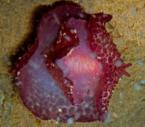
underside
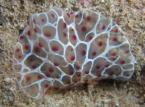
young
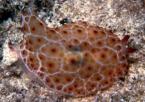
young, about 60 mm
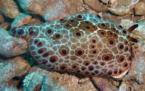
transitional
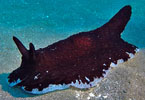
cream spots
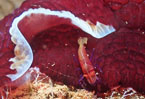
with shrimp
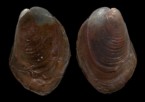
shell
_______________
GALLERY

Pleurobranchus grandis Pease, 1868
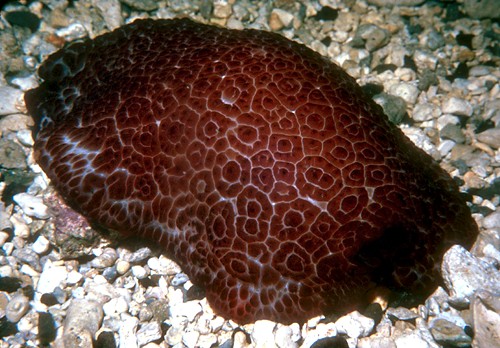
| Maximum size: about 300 mm.
(Hoover, 2006); perhaps as large as 800 mm (Kay, 1979). Identification: The notum of this species is covered with a tile-like pattern of flattened tubercles composed of rings of smaller tubercles surrounding larger central ones. Most mature Hawaiian animals range from dark red brown to deep violet (cream and cream-spotted forms that are common elsewhere in the Indo-Pacific are rare in Hawaii). Very young animals are cream with violet-brown tipped tubercles that are less developed than in mature animals. Clusters of tubercles are separated by a network of white lines that disappear as the animal matures. Natural history: On Maui, Pleurobranchus grandis is a moderately rare species that we've found at moderately exposed to exposed rocky sites at depths of 5-10 m (15-33 ft) as well as in moderately protected sand habitats at 18 m (60 ft). However, it's listed as "fairly common at depths of about 30 m (98 ft)" in Kay, 1979 and has also been photographed to depths of 74 m (243 ft) by HURL submersibles. Rarely, it can be found in tide pools. Like Pleurobranchus forskalii, it usually carries the posterior portion of its mantle in a siphon-like fold (see photo). Distribution: Big Island, Maui, Oahu and Kauai: Widely distributed in the Indo-Pacific. Taxonomic notes: The description of Pleurobranchus violaceus Pease, 1864 in Kay, 1979 appears to refer to this species. Goodheart, et. al. (2015) tentatively lists Pleurobranchus violaceus Pease, 1863 as a synonym of P. grandis. However, it also seems possible that Pease's animals were Pleurobranchus peronii (due to ambiguity in the description and the likely depth of collection). It's listed as Pleurobranchus sp. 2 in Hoover, 1998 and is referred to as the "tiled pleurobranch" in Hoover, 1998 & 2006. Photo: Scott Johnson: about 150 mm: found by Stan Jazwinski; Kihei, Maui; Aug., 1977. Observations and comments: Note 1: ( ) |
| Thumbnails |
Species
list |
Family | Next species | Top |