
| Home |
| Acknowledgments |
| Conventions |
| Glossary |
| Maps |
| References |
| Links |
| Articles |
| Thumbnails |
| Species
list |
| Family |
| Next
species |
Additional Photos
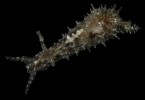
without ocelli
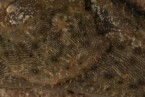
ocelli detail
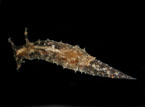
interrupted lines

without lines
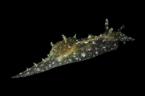
side
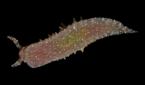
underside
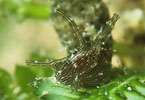
front
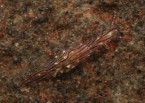
young
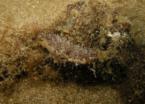
in field
drifting
swarming
with shrimp
predation
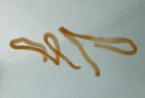
egg mass
_______________
GALLERY

Stylocheilus striatus (Quoy & Gaimard, 1832)
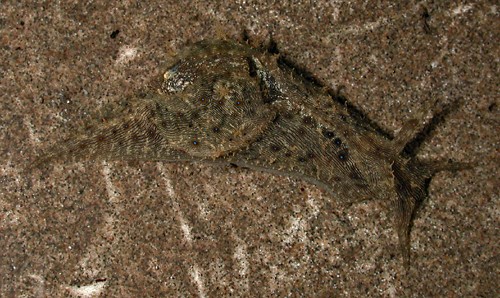
| Maximum size: 57 mm (Ostergaard, 1955). (Note 1) Identification: This is a small, papillate sea hare with low parapodia. Its body is cream marked with fine, longitudinal brown lines that may be interrupted or absent in some animals. (Note 2) It is usually decorated with blue and gold ocelli when mature (young animals may lack ocelli and the ocelli usually become more prominent and numerous with age). Mature animals lack a shell although it's present in very small juveniles. In general, the papillae (or villi) are not as elaborate as in Phycophila euchlora. Natural history: Stylocheilus striatus is probably the most common opisthobranch in Hawaiian waters, often representing over 50% of the animals in quantitative samples. It is found in rocky habitats and Halimeda kanaloana beds in protected to highly exposed locations. It occurs in tide pools and subtidally from depths of < 1 to 34 m (< 3 to 110 ft). It is primarily nocturnal although it often remains in the open during the day. It feeds on cyanobacteria (blue-green algae), particularly of the genus Lyngbya, and the blue and gold ocelli may represent aposematic coloration "advertising" the presence of toxins concentrated from its food. (Note 3) During any month of the year (though more commonly in spring/summer), when populations are high, it can form vast "locust-like" swarms that migrate across the bottom stripping the substrate of cyanophytes as they advance. (Note 4) When food is exhausted, entire populations may release from the bottom and drift off on the current with the animals using mucous strings as "sails." (Note 5) Most drifting seems to occur at night although it's possible that populations may release during the day in response to stress. (Note 6) Because of this behavior, large numbers may suddenly appear in new areas when currents concentrate and deposit drifting swarms. Stylocheilus striatus releases a purple dye when disturbed (though the "sensitivity" varies) and lays a tangled, golden-brown egg string that hatches in six to seven days in the laboratory. It's eaten by Philinopsis speciosa. Distribution: Big Island, Maui, Lanai, Molokai, Oahu, Kauai, Niihau, French Frigate Shoals, Laysan, Midway and Kure: widely distributed in the Indo-Pacific. Taxonomic notes: This is the species listed in Kay, 1979 and Hoover, 1998 as Stylocheilus longicaudus (Quoy and Gaimard, 1824). It is referred to as the "lined sea hare" in Hoover, 1998 & 2006. It was first reported from Hawaii in Gould, 1852 (as Stylocheilus lineolatus) and is listed in Edmondson, 1946 and Ostergaard, 1955 as Notarchus lineolatus. It's listed in Ostergaard, 1950 as Notarchus striatus. Aclesia areola Pease, 1860 is a synonym. Photo: CP: ocellate; 50 mm: Hekili Point, Maui; July 12, 2005. Observations and comments Note 1: Daniel Jennings-Kam reported an S. striatus held in a tank at Sea Life Park that was about 150 mm in length. Then, a population of a few dozen in an artificial pool at Captain Cook on the Big Island reached up to 100 mm. Also, when CP was visiting a marine lab in Moorea, there was an unused sea tank with water flow that held nothing but algae and half a dozen S. striatus that were 100-200 mm in length. So, if it has unlimited food, no need to move and no predators, it can get much larger (and, might do so in the field under unusual conditions...). Note 2: Many large animals in a population of a few dozen living in an artificial pool at Captain Cook on the Big Island lacked dark lines. Others in the same population had lines, though often reduced. Perhaps, lack of lines resulted from an abnormal diet in the pool? The algal turf in the pool seemed to consist mostly of filamentous green algae rather than blue-green algae... Lined and unlined animals engaged in mating/egg laying aggregations with each other. Note 3: This species, Phycophila euchlora, other ocellate sea hares that aren't present in Hawaii and most of their various mimics such as Aegires exeches and Scyllae sp. #1 appear highly cryptic from a distance but have very similar blue and gold ocelli when viewed at close range. Perhaps, they're under simultaneous selective pressure from two groups of predators with very different visual systems (maybe, fish and crustaceans such as mantis shrimp?). Together, they seem to represent a large mimicry complex similar to the "black-and-yellow" terrestrial insects (associated with stinging bees and wasps) and including both batesian and mullerian components (maybe, with the sea hares representing the primary models?). As with its terrestrial analog, there are other species in the complex that combine the colors in a less precise manner (such as Stylocheilus longicauda, Dendrodoris krusensternii, Miamira sinuata, Odontoglaja sp. #1, Lobiger viridis and Oxynoe jordani). At least three Hawaiian crab species, the prosobranch Eratoena sandwichensis, several small fish and the urchin Astropyga radiata (another possible model) may also be involved. Elsewhere in the Indo-Pacific there are several additional species that appear to be part of the complex. Note 4: We've observed vast swarms composed of many thousands of animals on the bottom on several occasions, both by day and night. By day, they seem to form more concentrated "windrows." At night, they seem to spread out more, presumably while feeding. Repeated observations suggest that they migrate slowly across the bottom. Note 5: On several occasions at Hekili Point, Maui we've noted large populations appearing or disappearing over a few days in an area of the trough that we visit regularly. It is well protected by an offshore crest but has a moderate long-shore current that tends to concentrate drifting material. On at least three occasions during low tides at night, we've observed very large numbers of S. striatus on the bottom with moderate to very large numbers drifting in the water column suggesting recent settlement or release. One such sequence may be particularly informative. In fall, 2007 we'd noted an area with unusually rich cyanophyte growth (primarily Lyngbya majuscula) in the trough west of the point. During several visits between Oct. 30 and Nov. 25 we'd seen only a few scattered S. striatus in the area. However, during low tide on the night of Nov. 26 we found immense swarms covering the bottom. During low tide on the night of Nov. 27, we encountered many thousands of animals drifting in the water column starting in the cyanophyte area and continuing down-current for 100-200 m. When the bottom was examined in detail during the day on Nov. 28, it was found that the cyanophytes had been stripped from the substrate and there were only moderate numbers of scattered S. striatus remaining. Subsequently, moderate numbers were seen through Dec. 11 during several visits. From Nov. 25 till Nov. 28 the surf was low and there was no sign of mass mortality. Such observations would seem to support the suggestion that the species uses a "release and drift" strategy to move between patchy concentrations of their food algae. Note 6: On May 30, 1992 in the trough just east of Hekili Point, an area with somewhat restricted circulation and depths of 1-2 m (3-6 ft), we saw many hundreds drifting in the water column when returning to shore from a snorkel in the late afternoon. It was at high tide and during a period of unusually low surf and warm weather. Although the resident population in the area hadn't been previously noted, the circumstances suggest that they had recently released from the bottom. The drifting animals were of all sizes and the water seemed unusually warm. This might support the suggestion that populations may also release and drift in response to high temperature or other stress. The animals appeared healthy and there was no sign of mass mortality. |
| Thumbnails |
Species
list |
Family | Next species | Top |